

TLDR: Technology leaders build credibility by creating reliable operations, keeping commitments, and making it easier for teams and stakeholders to work together. Niel Nickolaisen recommends combining IT service management, Agile, and lean to reduce recurring issues, improve delivery, simplify processes, and create a culture of ownership and continuous improvement.
Pro Tip: If you would rather watch the on-demand webinar, head to the Leadership Webinar Series - Session 2: Operational Excellence, Delivery and Credibility video on www.vlcm.com/webinars.
 Technology leaders are being asked to play a different role than they did in the past. As Niel Nickolaisen, Field CTO at VLCM, explains in a recent VLCM Technology Leadership University webinar, IT is no longer just a support function. Because nearly every organizational capability now has a technology component, technology leaders have to help influence where the organization goes next.
In his second session of VLCM’s Technology Leadership University, Niel focused on the delivery component of influential leadership. His central message? Before technology leaders can guide strategy, modernization, or innovation, they must establish credibility through operational excellence. To build that credibility, Niel recommends combining three proven disciplines: IT service management, agile principles, and lean thinking.
The Operational Excellence Trifecta
Before technology leaders can influence strategy, they have to show that IT can deliver consistently. Niel argues that reliable delivery does not require a new methodology. It comes from combining three established disciplines, each addressing a different challenge:
- The ITIL Core (Production Change, Incident Management / Root Cause Elimination, Service Definition, and Management)
- Use Agile as an operating system to help teams move forward when conditions are uncertain.
- Lean to reduce waste, friction, and turbulence that slow work down.
Together, these disciplines - and their associated culture - help IT teams reduce disruptions, improve delivery, and build the credibility needed to influence larger decisions across the organization.
“Why does this matter?” asks Niel. “Because our ability to have people choose to follow us is based on our credibility. My peers and leaders are not going to trust me to take the organization to the future if I’m the person who leads the game and can’t shoot straight.”
So? We've got to get good at this.
Focus on These Three ITSM Fundamentals First
Niel recommends initially concentrating on three foundational areas of ITIL (Information Technology Infrastructure Library) and IT service management:
- Production change
- Incident management and root-cause elimination
- Service definition and management
Production Change
Production change is especially important because many system outages are self-inflicted problems. Furthermore, a poorly tested deployment or unclear communication can disrupt employees and customers while damaging IT’s internal reputation.
As such, Niel recommends three straightforward requirements for every production change:
- Define, execute, and successfully complete a test plan.
- Create a way to quickly roll back the change if it fails.
- Make sure affected stakeholders know what is coming.
So what does this look like in practice? Niel shared that in a previous role, IT made two production deployments each week, and one or both regularly disrupted systems used by 50,000 users. “They hired me because the impression was that IT couldn’t do anything right. It was a black hole. Projects went in, nothing ever came out,” says Niel. “IT had really low credibility. What do we do with a credibility problem? Let’s start with production change.”
Niel implemented a refined production change meeting. The first rule? “We don’t deploy anything to production until there has been a defined, executed, and successful test plan,” using the three requirements listed above. The reality? “It took about three weeks before anybody had any qualifying production changes. After that? Downtime went away.” Niel and his team started tracking downtime not in weeks, but in months - growing IT’s credibility dramatically.
Incident Management
Niel asks, “How much of our lack of credibility comes from repeating the same mistakes over and over, or having the same problem over and over?” Rather than closing an incident and moving on, teams should track it until they identify both its immediate cause and the underlying issue that allowed it to happen.
Niel recommends reviewing incident trends with the team each month, selecting one or two of the most frequent problems, and determining whether the cause lies in a process, policy, or technology. Eliminating those causes reduces disruptions for users, shifts more of the team’s time from unplanned to planned work, and creates greater capacity for innovation.
Service Management
Next, “we have to be good at service definition and management,” says Niel. To do this, you need to classify your services and align your responses around their criticality. What this means is when we’re talking about things like production change or service management, or incident management, “my rule of thumb is I want our processes to be as simple and clean as possible, because the more complex they are, the less likely they are to work.” Secondly, the more complex a process becomes, the more likely people are to work around it. Defining service criticality in advance helps teams make faster, more consistent decisions about change controls, escalation, recovery, and where to focus limited resources.
Get Agile
Niel encourages technology leaders to think about agile more broadly than merely standup meetings or two-week sprints. Instead, Agile is an operating system for handling uncertainty.
That uncertainty exists not only in software projects but also across multiple avenues of the business. Organizations may try to manufacture certainty through detailed forecasts and plans, but conditions will always change.
Instead, use Agile principles to help your team respond to that reality, including:
- Focusing on accomplishments rather than activity
- Prioritizing the work that matters most right now
- Shortening feedback loops
- Collaborating to make decisions
- Empowering the people closest to the work
- Delivering working outcomes frequently
- Embracing change
- Continuously improving
For leaders, Agile means setting the outcome, priorities, and expectations while giving the team ownership of how the work gets done. Leaders should establish who the work serves, clarify accountability, and ask for frequent progress and feedback. The team can then adjust its approach as it learns.

Give Teams Ownership and Hold Them Accountable
An Agile operating model also changes the relationship between leaders and their teams. Leadership should establish the direction and design the environment in which work takes place, while the people closest to the work own how it gets done. Teams should also be responsible for setting and keeping their own commitments.
That requires building a culture of psychological safety. Team members must be able to provide honest estimates, identify risks, question unrealistic expectations, and make informed decisions without being pressured into commitments they cannot meet.
“The way I think about leadership,” says Niel, “is my job is to design the container inside of which the work takes place. The container design is based on trust and ownership. I trust the teams to deliver, and the teams take accountability to deliver.”
Make Your Processes as Simple and Lean as Possible
Lean is the relentless, systematic elimination of waste. In technology work, waste may include everything from rework to cultural practices that prevent people from solving problems. Niel encouraged leaders to think about processes in terms of flow.
Friction slows a process down, while turbulence disrupts it. Bureaucracy, unnecessary approvals, unclear handoffs, excessive exception handling, and control-based cultures can all interfere with the flow of value to customers.
“Every supplier/customer relationship must be direct and unambiguous, and the pathway for every product and service must be simple and direct. (As leaders) we’re providing services to our customers, whether they be internal employees or external customers, or both.”
Lean culture also treats people as problem solvers instead of problems. “When there’s a problem, it highlights a process issue. We solve the process issue, and we roll it across the board. If someone makes a mistake - and they will - you blame and fix the process. You never blame and fix the person.”
“I train everyone,” says Niel, “A part of that training is to identify an area of waste in their work and then use the appropriate tool to resolve that, to eliminate the waste.” Don’t allow the fear of not reaching perfection stop you from getting better. If improving a part of the process makes it even a little better, “let’s enjoy better now.”
Fix Recurring IT Issues - here’s where to start
IT teams often spend significant time responding to outages, recurring incidents, and interruptions. Every disruption takes time and attention away from strategic priorities.
Niel recommends reviewing incident data on a monthly basis. Identify the most frequent issues, determine their root causes, and start eliminating them one at a time. Ask yourselves, is it a practice issue? Is it policy? Maybe it’s technology! Whatever it is - eliminate it. And make sure you’re reviewing these incidents at a regular basis.
“The thing that is important,” explains Niel, “is the issues don’t just affect us. It affects our users. Somebody can’t do their work when there’s an issue.” If you stop the incidents from ever happening again, your credibility goes up.
The Two Questions That Measure IT Credibility
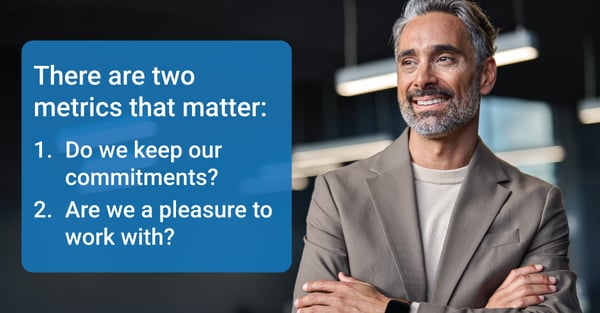
After experimenting with numerous technology metrics, Niel ultimately identified two questions that matter most:
- Do we keep our commitments?
- Are we a pleasure to work with?
Niel adds, “Everything cascades (from these two questions). Do we keep our commitments? We said we get this done. Did we? We said it would work this way. Does it? And are we just wonderful to work with?”
He concludes with a challenge, “Think about how you build in a culture of continuous improvement. Are we getting better every day?” If you can’t get better every day, can you get a little better every week? If you can’t, what about every month?
“Think about the culture you want to build,” says Niel, “Train everybody. They've got to know what to do. You can’t just say, get better at something. You need to give them a framework to use.” If you’re not already, start including specific process improvements when planning and prioritizing the things you want to get done, like:
- New initiatives
- Modernization
- Rationalization
- Process improvements
- Culture improvements
- Research and development
VLCM’s Technology Leadership University gives IT leaders frameworks for improving how their teams operate and lead. In just thirty minutes a month, the series is a strong starting point for building credibility and increasing influence across the organization.
Niel is a technology leader, mentor, and advisor. He has authored two books: The Agile Culture: Leading Through Trust and Leadership and Stand Back and Deliver: Accelerating Business Agility. He has written hundreds of articles on modernization, technology alignment, AI readiness and use cases, and technology selection, and currently serves as an Adjunct Research Advisor at IDC. Follow him on LinkedIn.


